musical-production/electronic-production

Electronic Music How to Make Cero Electronics

A Ander B
Updated Jul 2025
Electronic Music How to Make Cero Electronics

Electronic Music How to Make Electronic from Scratch

How ​​to make electronic music?

To take your first steps in electronic music production, it is essential to understand the fundamentals, including the necessary equipment and software. Starting with friendly software like Ableton Live and a suitable computer, either PC or Mac, is a great start.###What basic equipment do I need to make electronic music?

Essential equipment to get started includes a computer with appropriate specifications, quality headphones and, possibly, a studio monitor. Additionally, it is advisable to have a reliable audio interface, especially if you plan to record instruments or vocals.

Before you begin creating your first theme, it is crucial to select the right equipment. Find out how to choose the music production software to get you on your way and what hardware and drivers you’ll need to make attention-grabbing electronic music. We will also guide you in choosing studio monitors and headphones that will allow you to fine-tune your tracks to perfection.

Making your first electronic music song is a final moment in your musical career. We will teach you how to structure your song so that it flows, comfortable life to the beats and the lines underneath that will be the basis of your sound. Additionally, you’ll learn about synthesis and sound design to infuse personality and character into your productions, ensuring every mix sounds flawless in any environment.

For those wondering how to start producing electronic music, immerse yourself in the different genres and understand the essential music theory. You’ll learn to differentiate between house, techno, trance and more, while becoming familiar with the scales, chords and harmonic progressions that form the backbone of electronic music. This knowledge will give you the freedom to experiment and create music that not only sounds good, but also resonates emotionally with your audience.

Sound design and synthesis are the heart of electronic music production, where the character and texture of your sound come to life. In this section, you’ll learn how electronic music producers use oscillators, filters, and modulators to craft unforgettable soundscapes. Whether creating hard-hitting beats or ethereal atmospheres, you’ll have the tools and techniques at your disposal to make every moment work for you.

Selecting the right songs and samples is a crucial step in producing electronic music that stands out. Explore how you can use pre-recorded sounds or develop your own with synthesizers and samples. These skills are essential to giving your tracks the distinctive quality sought by DJs and electronic music enthusiasts around the world.

After selecting your sounds, the next step is to learn the art of mixing in electronic music production. This process is crucial to ensuring that every element of your track, from synths to drum samples, is heard clearly and complements each other. We’ll walk you through equalization and compression techniques so that your tracks not only sound professional, but also capture the energy and dynamics of modern electronic music.


📸 Fotograma Específico de Referencia (Fotograma 1)

Fuente y Atribución: Captura de pantalla técnica extraída en el minuto exacto del tutorial educativo por Laidback Luke / Pioneer DJ.

Fotograma Técnico: Matriz Rueda de Camelot (04:15)


PC or Mac: which is better for music production?

The choice between PC and Mac depends on your personal preferences and your budget. Both systems can be efficient for music production, but it is crucial to consider technical aspects such as processor capacity, RAM, and storage space.###Which music production software is recommended for beginners?

Ableton Live is a great option for electronic music producers who are just starting out. It offers an intuitive interface and is widely used in the industry. ###How ​​to choose the right headphones and monitor for music production?

When selecting headphones, look for those that offer clear and accurate sound reproduction. For studio purposes, consider the acoustics of your space and whether you need active or passive monitors.

Mastering is the final touch that elevates your music, preparing it to be enjoyed in any environment, from headphones to nightclubs. In this article, we’ll share with you mastering principles designed for emerging electronic music producers, ensuring your tracks are polished and ready to compete in today’s market.

As you progress, you’ll want to delve into more advanced production strategies. We’ll cover everything from implementing automation techniques that add life and movement to your tracks, to creatively using effects to completely transform a sound. Plus, you’ll be introduced to the world of audio sampling and editing, where you’ll learn how to clip, stretch, and manipulate samples to produce unique, custom effects.


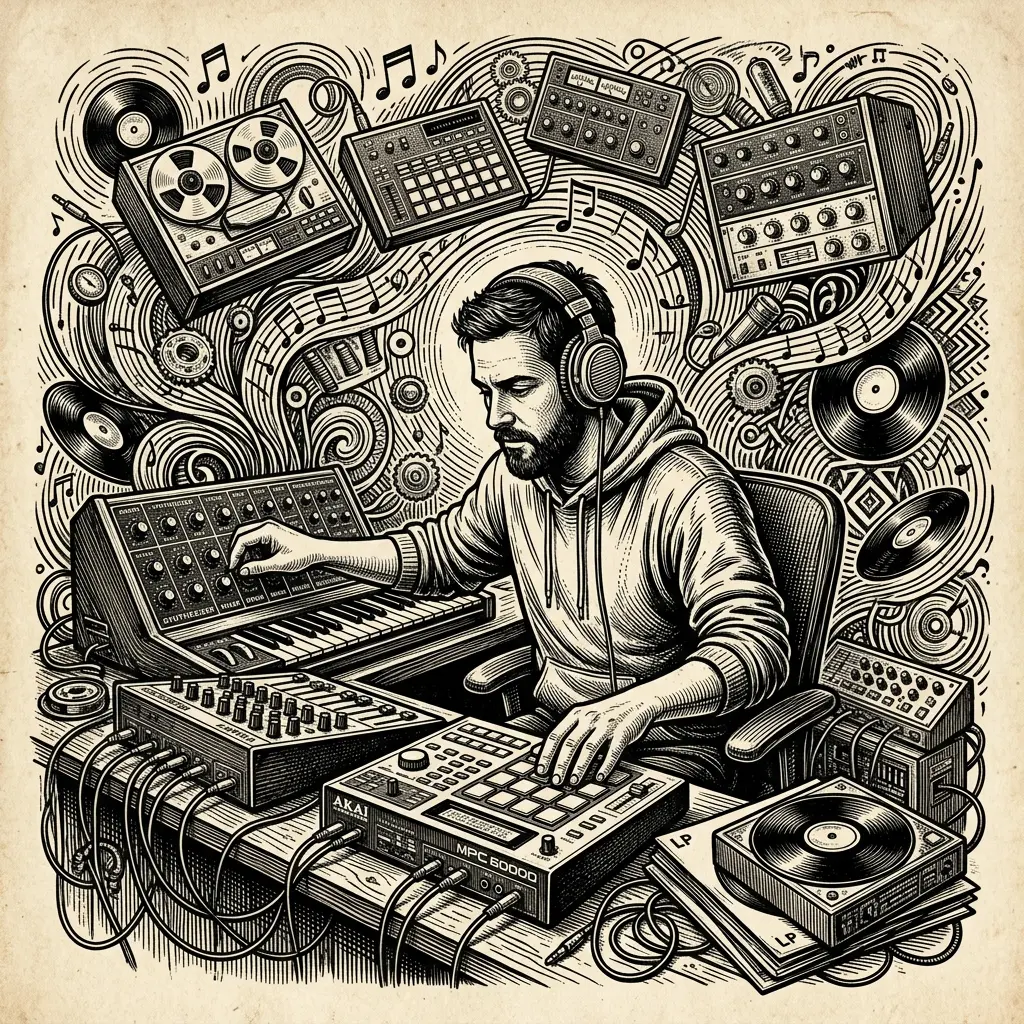
🎛️ Equipamiento Técnico & Cadena Analógica en Estudio (Imagen 2)

AKAI MPC Live PA & Síntesis Analógica en Barcelona

Estación de secuenciación dawless con AKAI MPC 1000 y sintetizadores analógicos en acción.


Essential Equipment

To start producing electronic music, you need to have essential equipment. In this section, the basic elements required to begin production will be detailed.

Music Production Software

Choosing the best Software and Hardware

Success in electronic music production is not only based on talent, but also on the tools you use. We’ll delve into how to select the software and hardware that complements your workflow, highlighting programs for producing electronic music that are indispensable for our current products. We’ll also give you tips for choosing controllers and synthesizers that will expand your creative possibilities.

Music production software, also known as DAW (Digital Audio Workstation), is the fundamental tool for producing electronic music. There are several programs on the market, such as Ableton, Logic, and FLStudio, that are very popular among Producers.

Each DAW has its own features and benefits, so it’s important to do your research and choose the one that best suits the producer’s needs and preferences. Once you have chosen the software, it is essential to learn to use it correctly and know its main functions.

Hardware and Drivers

In addition to software, it is important to have certain hardware and drivers to improve the production experience. A good MIDI keyboard can be a great help in creating melodies and harmonies, while a pad controller can be useful for programming rhythms and percussion.

It is also recommended to have a quality audio interface, to be able to record instruments and voices with the best possible quality. A good microphone and studio monitors can also be a great help in improving sound quality.

Studio Monitors and Headphones

Studio monitors are speakers designed specifically for music production, as they reproduce sound more accurately and in detail than conventional speakers. It is recommended to have a pair of quality monitors to be able to mix and master the music adequately.

On the other hand, headphones are also an important tool for music production, as they allow you to listen to the sound with more detail and precision. It is recommended to have quality headphones to be able to work in noisy environments or to perform solo mixing and mastering.

In summary, the essential equipment to start producing electronic music includes music production software, hardware and dual controls, and studio monitors and headphones. With these basic elements, anyone can start producing electronic music and enter the exciting world of music production.

Creating Your First Theme

How ​​important is the audio interface in music production?

The audio interface is essential to ensure optimal sound quality and efficient recording. A good interface for beginners should be easy to use, offer high sound quality, and be compatible with your software and computer. ###What additional resources should a beginner in electronic music consider?

In addition to the basic equipment, it was important to invest in MIDI controllers, plugins and sound libraries. There are also cheaper options to equip your studio without sacrificing quality.

Once you have chosen your music production software and are familiar with its interface, it is time to start creating your first song. Creating a song may seem daunting at first, but by following a few basic steps, anyone can create their own electronic music.

Song Structure

Before starting to create a song, it is important to take into account its structure. Most electronic music songs follow a basic structure of intro, verse, chorus, and bridge. It is essential to keep in mind that there is no fixed structure and that each song can be different.

Creating Beatsy Bass Lines

The creation of beats and lines underneath is an essential part of electronic music production. Beats are the basic rhythm of the song and are created using different drum and percussion sounds. The lines below are the basis of the song and think about using different sounds underneath. It’s important to experiment with different sounds and rhythms to find the one that best suits the song.

Synthesis and Sound Design

Sound synthesis and design are advanced techniques used to create unique, custom sounds for a song. Synthesis involves creating sounds from oscillators, filters, and other modules. Sound design involves manipulating existing sounds to create new sounds.

The Artedela Sound Synthesis

Mastering synthesis is a pillar in the creation of electronic music. This art allows you to build your children from scratch, opening up a world of sonic possibilities. We will teach you how to use oscillators, filters and modulators to design your own two that define your personal stamp on electronic music. From creating robust bass lines to atmospheric leads and pads, every sound will be a signature of your identity as a producer.

Mixing and Mastering

Mixing and mastering are the final processes in electronic music production. The mezclaim involves combining all the individual tracks into a single stereo track. Mastering involves optimizing the final sound so that it plays well on different sound systems.

In short, creating an electronic music song may seem daunting at first, but by following a few basic steps, anyone can create their own music. Song structure, creating beats and lines underneath, synthesis and sound design, and mixing and mastering are the essential steps in creating a successful electronic music song.

Dynamics and Volume in Electronic Production

A clear and well-balanced mix is ​​what differentiates an amateur production from a professional one. We will cover the essential techniques to achieve perfect balance and harmony in your mixes. You’ll learn how to adjust volume levels and apply compression effectively, ensuring your production has the desired impact on any sound system.

Equalization and Spatialization

Mastering mixing is essential for any aspiring electronic music producer. In this section, we will detail how to apply equalization techniques and use of space so as not to give each element of your track its rightful place in the mix. From frequency management to creating surround environments, these skills are vital to achieving a balanced, dynamic mix.

Advanced Production Techniques

Once basic music production skills have been acquired, it is possible to explore advanced techniques to improve the quality of productions. Here are two techniques that can help producers take their music to the Next Level.

Automation and effects

Automation is a technique that allows you to control the parameters of a virtual instrument or effect in real time. This allows you to create gradual changes to the sound, such as increasing the volume of a track as the song progresses. Automation can also be used to create effects, such as sweep filters, delays, and reverbs.

Effects are an important part of music production, as they can transform a simple sound into something more complex and exciting. Some common effects include distortion, chorus, and flanger. Producers can also use modulation effects, such as phase and tremolo, to create changes in the sound.

Sampling and Audio Editing

Sampling is a technique that involves taking a portion of an audio recording and using it in a new production. This may include taking a section of an existing song and using it as the basis for a new song. Producers can also use samples to create rhythms and melodies.

Audio editing is a technique that allows you to manipulate audio recordings to create new sounds. This may include cutting and pasting sections of audio, changing the speed of a recording, or adjusting the pitch of a recording. Audio editing can also be used to remove unwanted noise from a recording.

In short, automation and effects, as well as audio sampling and editing, are advanced techniques that can help producers create more exciting and complex music. By using these techniques, Producers can take their music to the Next Level and create more professional and exciting productions.

Final Review and Pre-Release Adjustments

The last step before releasing your music into the world is to make sure every detail is polished. We’ll discuss the importance of a meticulous final review and how to make pre-release adjustments that ensure your music lives up to industry standards. From reviewing transitions to fine-tuning effects, every step is crucial to the success of your production.

Where can I find online training to produce electronic music?

There are numerous online courses available for those who aspire to be Electronic Music Producers. These courses can range from basic tutorials to more advanced and specialized programs.###How ​​difficult is it to make electronic music?

Difficulty varies depending on previous musical experience and skills. With the help of intuitive software and online educational resources, even beginners can start producing electronic music effectively.

Sound is the bridge between chaos and harmony. Use the hardware to your advantage.—Ander B

Do you want your next track to sound in the big leagues? More than 500 tracks produced at MPCEstudio BCN. Book an online or in-person session at our studio in L’Hospitalety and elevate your Sound to the mainstream standard.


🚀Take your Sound to the Next Level

Are you looking for a professional sound, analog mix or exclusive instrumentals? At MPCEstudio Barcelona we work with the best hardware in the industry so that your music competes in the big leagues.

👉Contact us via Whats App to book your session or request a custom pr es up or this.


📸 Demostración Práctica en Pantalla (Fotograma 3)

Fotograma Técnico: Ajuste de Ecualización & Limitación (15:10)

Captura de Referencia: Explicación técnica de procesado extraída del canal de autoridad Waves Audio / Pensado’s Place. Calibración del medidor de sonoridad para sesiones de club y streaming.


🔥 TURN THEORY INTO INDUSTRY-STANDARD SOUND

READY TO ELEVATE YOUR TRACKS TO THE NEXT LEVEL?

Don't let your talent get lost in bedroom-quality demos. Work 1-on-1 with Ander B at our Barcelona studio (Neve 1073, SSL, AKAI MPC) or train at our exclusive analog academy.

📍 Barcelona City Center · ⚡ Reply in < 2 hours